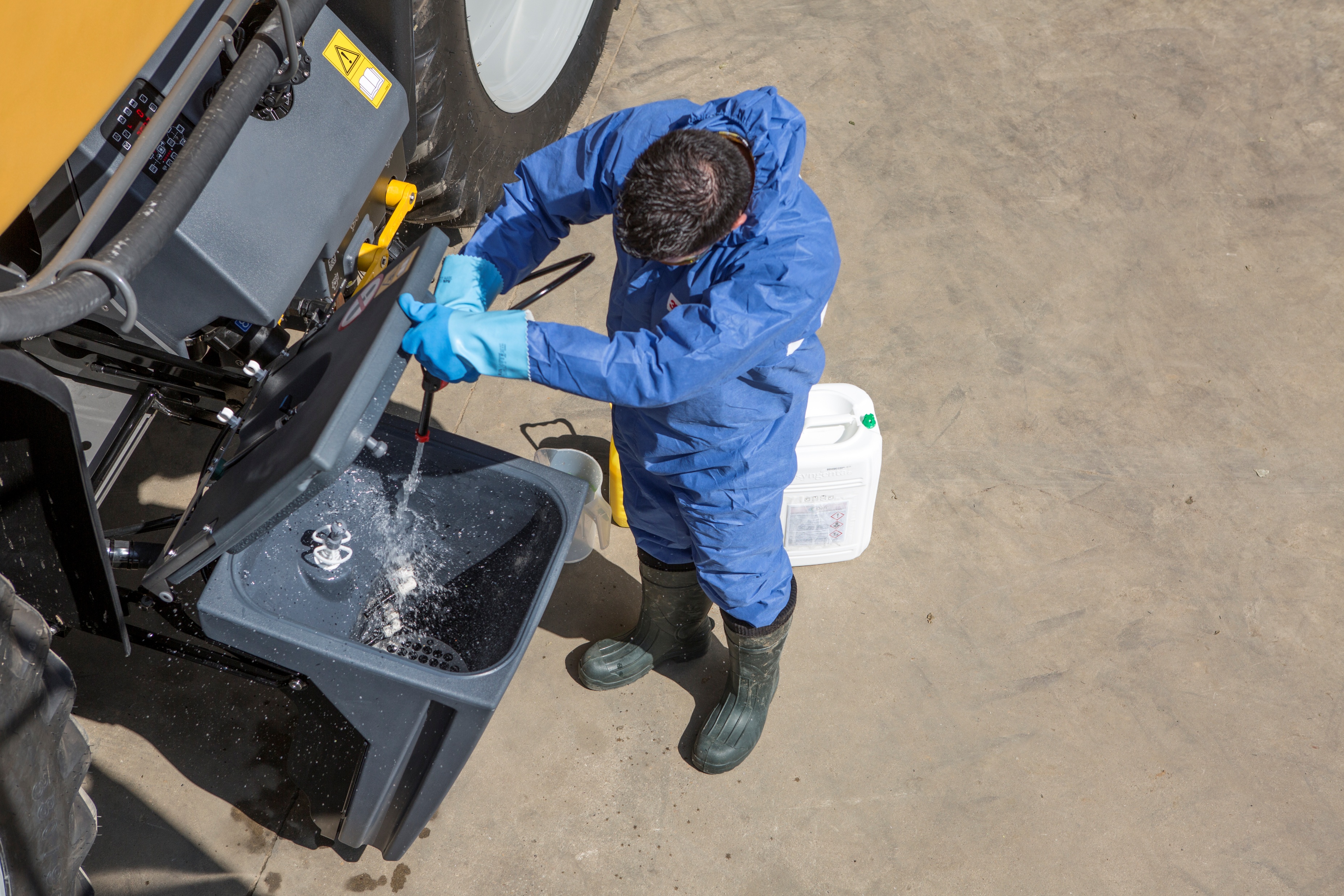
In theory, every glyphosate application starts with 100% potential performance.
In practice, that performance is steadily influenced – and often reduced – by a series of decisions and conditions between filling the sprayer and hitting the target weed.
Herbicide Technical Lead, Bayer
Commercial Technical Manager, De Sangosse
Midloe Grange Farm
Principal Weed Scientist, ADAS
At LAMMA CropTec 2026, De Sangosse hosted a technical panel discussion exploring how those influences interact across the full spray journey – from tank chemistry through to application practice and field conditions.
The session, From Tank to Target – Making Every Glyphosate Spray Count, brought together practical farming experience, independent research and technical expertise to help growers protect glyphosate performance this spring.
A key message from the session was that disappointing glyphosate results are rarely caused by a single failure. Instead, performance is shaped by multiple interacting factors, including:
Glyphosate performance is eroded by multiple small compromises
- Roger Bradbury, Herbicide Technical Lead, Bayer
- not one single failure
Each factor on its own may only reduce performance slightly. But together, these small losses can accumulate, leaving applications underperforming despite appearing “correct” on paper.
Opening the discussion, Roger Bradbury explained that this is something many growers recognise in the field.
“Most poor control isn’t down to once obvious mistake,” he said. “It’s usually a series of small compromises. When they stack up, you don’t get the result you expected.”
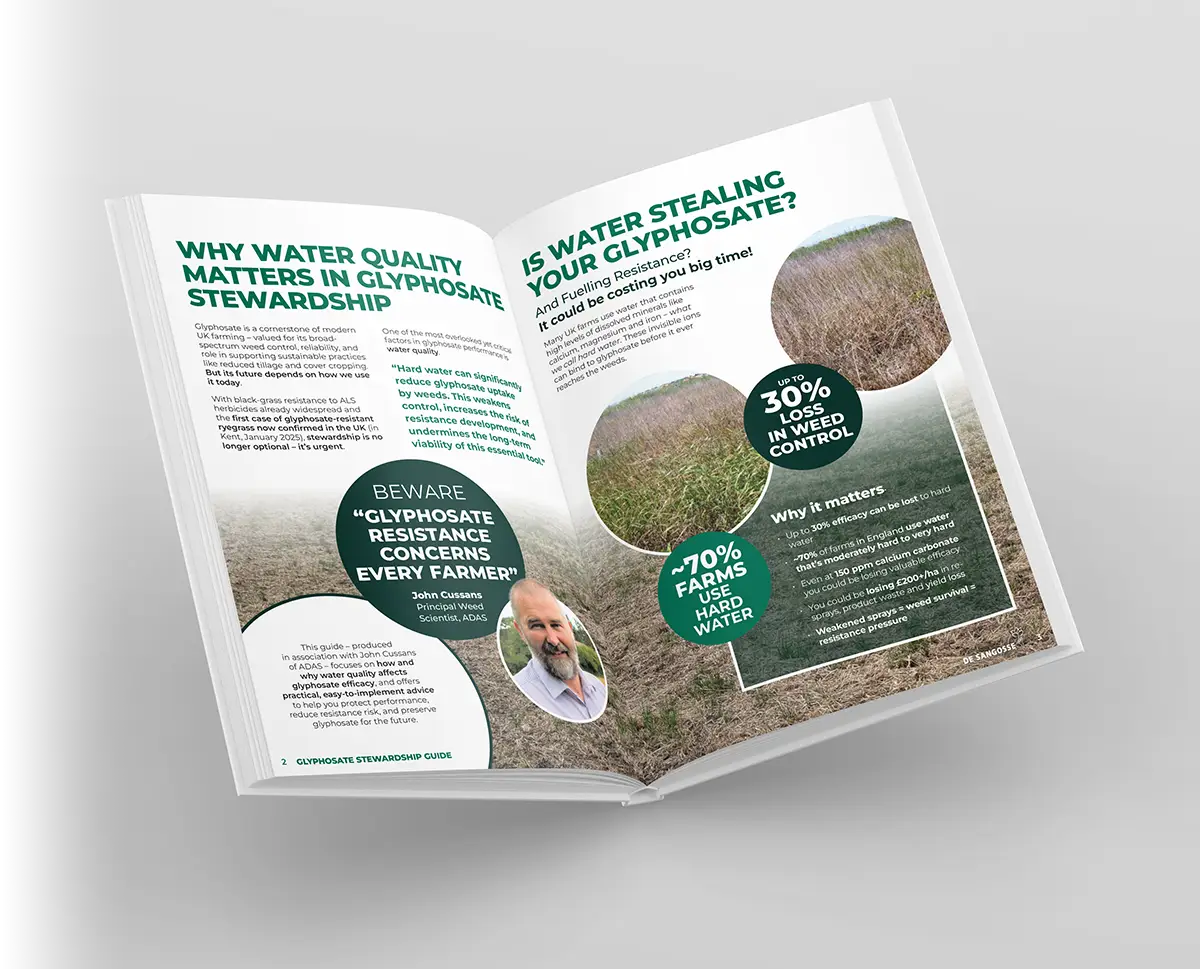
Among all the factors discussed, water quality – and specifically water hardness – emerged as one of the most consistently overlooked risks to glyphosate performance .
Rob Suckling, Commercial Technical Manager at De Sangosse explained how calcium and magnesium ions present in hard water bind with glyphosate molecules, reducing their biological availability both in the spray tank and on the leaf surface.
“This isn’t about pH,” he emphasised. “You can have neutral pH water that is still very hard. If calcium ions are present and unmanaged, glyphosate efficacy can be significantly reduced.”
With many arable regions routinely using moderately hard to very hard water, this means a large proportion of glyphosate applications may be unknowingly compromised before the sprayer even leaves the yard.
Using a conditioner occasionally, or at a guessed rate, is one of the biggest risks we see. Water hardness varies, depending on water source and how it is stored, so testing is important and conditioning needs to be correct – and consistent – every tank.
– Rob Suckling, Commercial Technical Manager at De Sangosse
Rob addressed a common issue raised during the session: while some operators now use a water conditioner, it is often applied inconsistently or at an incorrect rate.
“Using a conditioner occasionally, or at a guessed rate, is one of the biggest risks we see,” he explained. “Water hardness varies, depending on water source and how it is stored, so testing is important and conditioning needs to be correct – and consistent – every tank.”
Testing for water hardness is straightforward, with the TDS meter being the quickest and easiest for farmers to use. Available through De Sangosse free of charge, these meters provide a digital reading of water hardness that mean the required dose of water conditioner can be easily determined.
Most accurate. Takes a few days. Only accurate for the sample sent
For ongoing and fast testing. Quick and easy reading for daily use
Can be inaccurate. The strips only offer a ranged result.
The panel discussed why true water conditioners, designed to irreversibly bind calcium ions, offer the most reliable protection for glyphosate. By contrast, alternatives such as ammonium sulphate only partially mitigate the problem, while high rates of citric acid can reduce performance by forcing glyphosate out of solution.
Correct tank-mix order was also highlighted as critical, with conditioners crucially added to the spray tank before glyphosate to neutralise calcium ions before the active ingredient is introduced.
Always Apply glyphosate at the Correct Dose & Timing
Even with well-conditioned water, application decisions remain central to success.
David Felce, farmer and spray application expert from Midloe Grange Farm, stressed that target growth stage and spray delivery must align.
“Small, actively growing weeds are far more susceptible than stressed or stem-extending plants,” he noted. “Glyphosate must be translocated to the roots to be effective, but this does not happen in these scenarios.”
David Felce wrapped up his segment with the warning, “Always apply glyphosate at the correct rate for the weed size.”
Small, actively growing weeds are far more susceptible than stressed or stem-extending plants. Glyphosate must be translocated to the roots to be effective, but this does not happen in these scenarios. Always apply glyphosate at the correct rate for the weed size.
– David Felce, Farmer and Spray Application Expert from Midloe Grange Farm
“Spray volume, droplet size and nozzle choice all need to reflect where the weed is and how well it’s protected by the canopy.”
In reduced tillage and cover crop systems, weeds are often shielded, increasing the importance of getting droplets to the target and maintaining coverage – this is where choosing the right water volume and nozzle for the operation is an important consideration – particularly where glyphosate is relied upon as a crucial control tool.
The session concluded with a clear stewardship message: repeated sub-optimal glyphosate performance doesn’t just risk poor control in the short term – it increases resistance pressure and long-term costs.
The map adjacent shows populations identified in different regions that all share a similar background in terms of agronomy:
KEY FOR MAP ADJACENT
Suspected cases of glyphosate resistant ryegrass
Confirmed cases of glyphosate resistant ryegrass
Survivors matter. They are the individuals most likely to carry resistance traits. Left unchecked, the consequences are higher costs, more mechanical intervention and restrictions on farming systems.
- John Cussans, Principal Weed Scientist, ADAS
Even small numbers of surviving weeds have a disproportionate impact. They are more likely to tolerate glyphosate, more likely to reproduce, and more likely to shape future resistance. On those farms unfortunate enough to be now experiencing glyphosate resistant ryegrass, the following changes they have had to make should highlight to other farmers that it is easier to act before resistance occurs than it is after:
From tank-to-target, making every glyphosate spray count, has long-term implications for farmers. Protecting glyphosate performance protects both margins and management flexibility – particularly in systems where timeliness and cost control are critical.
You control the risk: Glyphosate resistance isn't inevitable - stewardship prevents it.
It is crucial to:
For additional information and to download our Stewardship Guide, click the link on the button below...
Visit the Clean Water. Clean Kill. Hub.
Clean Water. Clean Kill. Glyphosate Stewardship.
Practical guidance for better herbicide performance
Visit
Ferric Focus. Smarter Slug Control Starts Here.
Smarter slug control for reliable establishment
Visit
Phosphate Efficiency Pays.
Make every unit of phosphate work harder
Visit
Examples of glyphosate under-performing, courtesy of Bayer.